Pantrope is not a peptide company. We are building the delivery infrastructure for the next generation of consumer biology — starting with the one thing every person in the category hates but nobody has fixed. The needle.
Between three and eight million people today are self-administering peptide compounds. Not in clinics. In bathrooms, kitchens, hotel rooms, with a syringe, a vial of freeze-dried powder, and a YouTube tutorial open on a phone.
They do this because the results are real. BPC-157 for gut repair. GHK-Cu for tissue regeneration. TB500 for recovery. Epitalon for longevity. Molecules with decades of clinical evidence — most of it outside the FDA's timeline, and all of it now normalized at scale by internet communities that stopped waiting for institutional permission.
The demand is not emerging. It arrived. Quietly, without a press release, without a Category Creation Deck, without a single LP's blessing.
The experience of actually using these compounds, however, is barbaric. Reconstitute freeze-dried powder with a 25-gauge needle. Calculate microliter doses by hand. Inject subcutaneously, rotate sites, manage sharps, track degradation. Three to seven times a week. Alone.
The compounds work. The ritual is a disaster.
That is the whole business.
The pattern
Internet-native communities have spent seven years turning research chemicals into normalized daily rituals. Forums, Discords, Telegram groups ran the clinical trials that institutional capital would not touch. They moved faster than any IRB.
The demand they produced is economically real. The supply infrastructure is not.
Traditional capital stays out — anything adjacent to anti-aging, performance, or biological self-editing triggers LP risk memos. Regulators operate at 20th-century speed. The result: a large, growing consumer market with essentially zero institutional infrastructure serving it.
We have seen this pattern before — in crypto, prediction markets, every category where internet culture legitimizes demand years before the credentialed class. The operators who win ship better UX into the gap before legitimacy arrives.
Pantrope is that operator. In biology.
The chokepoint
Every emerging category has one thing that, if you remove it, the whole market unlocks. For peptides, it is not price. Not awareness. Not regulation.
It is delivery.
The needle. The reconstitution ritual. The cold-chain anxiety. The ten-step protocol that sits between a person and a molecule that could help them.
Remove that friction — make it as simple as a Nespresso pod — and the market does not grow incrementally. It multiplies. The person who will never inject will use a patch. The clinic that cannot spare a nurse will automate it. The medspa that feared liability will run it on a machine.
We are building the key.
Act one: Autonom
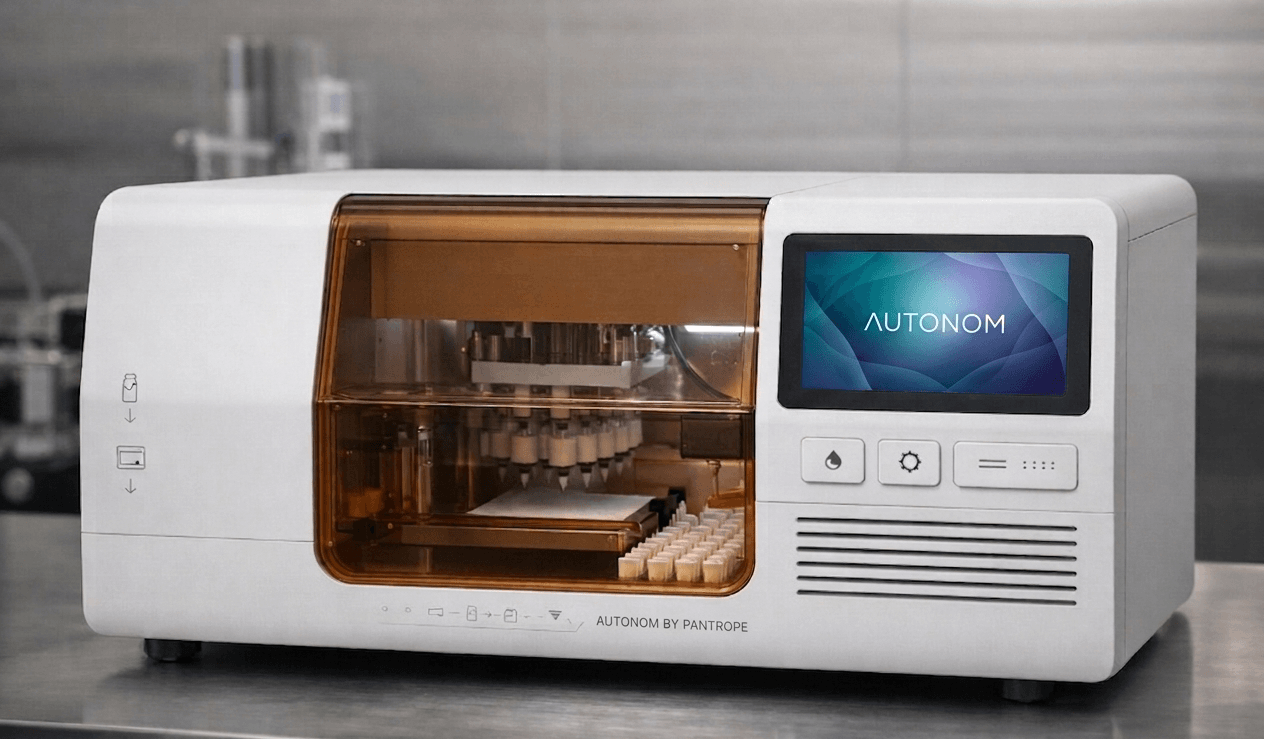
Our first product is Autonom — a tabletop autonomous reconstitution system. You load your vials. You press start. It handles sterile workspace, cap removal, disinfection, precision liquid handling, dissolution, and filtered output in four minutes. Without touching a needle.
Think of it as a Keurig for reconstitution.
The machine ships with its first cassette included. The cassette is a factory-sealed, single-use unit with sterile needle sets and diluent pathways for thirty cycles. When spent, it drops into a sharps bin. A new one clicks in.
That cassette is our recurring revenue. Every user becomes a subscription.
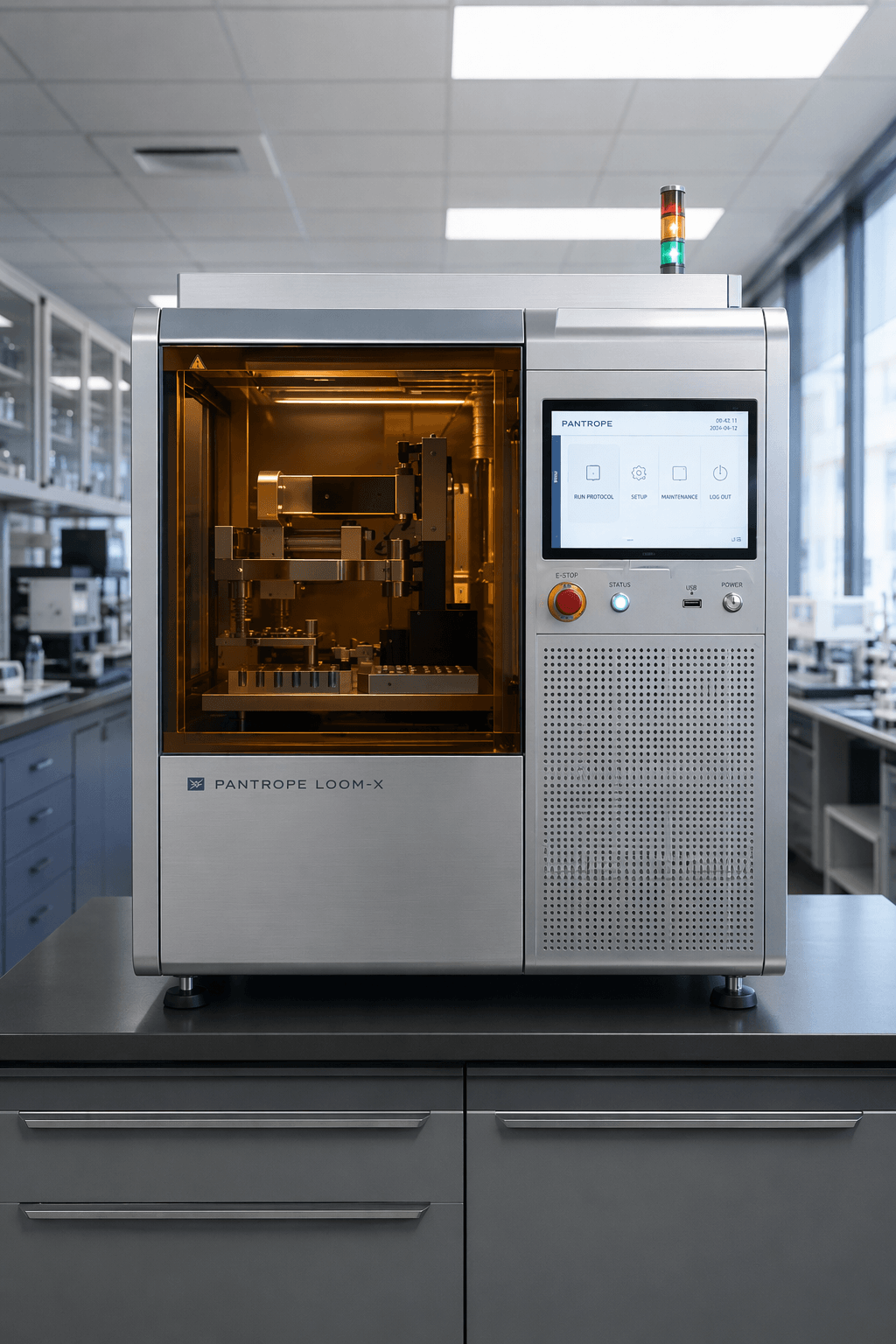
Same cassette. Two hardware price points. Two markets. One consumable SKU. This is the wedge — not all of biology on day one, but the most painful step in the most active consumer-bio category now.
Act two: the printer
The roadmap product is an on-demand dissolvable microneedle patch printer. Same Keurig logic. The machine ships with a cassette of biopolymer matrix and excipients. The user loads their peptide vial. The machine prints a patch at the point of care, to a dose configured in the app.
No needle. No injection. No ritual.
The cassette model holds. The platform holds. We go from solving reconstitution to owning the entire delivery stack — from powder to patient, without a single exposed needle.
The business
We operate like Keurig. The machine is the razor. The cassette is the blade.
Manufactured in India at a BOM that supports strong gross margin at both price points. Clinic customers burn cassettes at 30–50× home-user rates and have institutional procurement budgets. White-label licensing opens a third revenue line once the platform is established — wellness brands and pharmacies wanting to ship peptide protocols without building hardware.
Directional projections
| Year 1 | Year 2 | Year 3 | |
|---|---|---|---|
| Units shipped | 3,500 | 18,000 | 65,000 |
| Hardware revenue | $5.2M | $28M | $95M |
| Cassette ARR | $1.1M | $9M | $38M |
| Gross margin | 56% | 63% | 68% |
| Total revenue | $6.3M | $37M | $133M |
Cassette revenue compounds. It does not churn like software. The machine sits in the home or clinic, the ritual is automated, the reorder is default.
Why now
- I. Demand is already normalizedWe are not doing demand generation. Seven years of forum posts, YouTube tutorials, and Telegram groups did it for us. We are doing demand capture.
- II. Hardware is finally cheap enoughPrecision liquid handling, HEPA enclosures, microstepper systems — the BOM for a credible autonomous reconstitution device sits well below the price point that supports a consumer margin. This was not true five years ago.
- III. The modality shift is coming with or without usDissolvable microneedle patches have crossed from academic to manufacturable. The question is not whether peptide patches become mainstream. It is who owns the platform when they do.
The window is not years. It is quarters.
The mission
Collapse the distance between a molecule and the person it could help. Not by waiting for FDA blessing. Not by building another supplement brand. By building the infrastructure — hardware, cassette, platform — that makes the next generation of consumer biology as accessible as a morning coffee.
The needle is the metaphor and the mechanism. Remove it, and you remove the barrier between the demand that already exists and the scale that has not happened yet.